

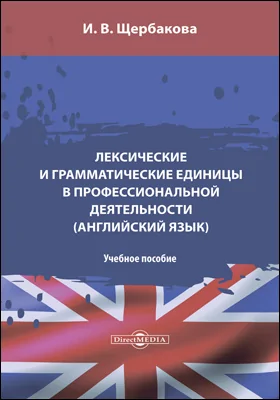

Лексические и грамматические единицы в профессиональной деятельности (английский язык)
Учебное пособие рассчитано на обучающихся первого курса факультетов технических специальностей и отвечает требованиям программы Министерства Высшего Образования Российской Федерации. Пособие включает два составных элемента (модуля): Topics & vocabulary и Grammar practice. Все модули состоят из разделов (Units). В начале каждого раздела первого модуля дается список лексики, тема, вопросы для вовлечения обучающегося в данную тематику. Затем идет основной текст, связанный с изучаемой темой, вопросы, контролирующие понимание текста, и/или упражнения, направленные на отработку навыков говорения.Каждый раздел включает в себя профессионально-ориентированные тексты для перевода с английского языка на русский со словарем. Второй модуль направлен на развитие грамматических навыков, включает грамматические упражнения, направленных на отработку и закрепление материала.

Содержание
Содержание книги "Лексические и грамматические единицы в профессиональной деятельности (английский язык) "
Отрывок из книги
Moscow, who may be called its founder. When the Italian architect Aris-totele Fieravanti was asked by Ivan III to reconstruct the old church in 1475, he was advised to go to Vladimir and study the Uspensky Cathe-dral, built in 1158. Fieravanti visited also Rostov, Yaroslavl, and the shores of the White Sea. Thus the Italian architect got first-hand infor-mation on Russian religious architecture and understood the main fea-tures of its traditions. So though the cathedral was designed by an Italian architect and engineer, its style and composition are Russian and Orthodox. The Moscow cathedral was completed in 1479; it is like the Vla-dimir cathedral, but is far from being a literal copy. The two cathedrals are of the same width, but the Moscow one is much longer; the Moscow cathedral has three aisles and five apses, the Vladimir cathedral has five aisles and three apses. The Moscow cathedral has six pillars, four of which – huge circular columns – support the central cupola, which is sur-rounded with four smaller cupolas. The facade is decorated at mid-height with a band of arcatures and a deeply recessed portal. 2. Answer the following questions. 1. What was Russia’s main cathedral? 2. How was it used? 3. Why would it be called a chapel in the West? 4. Why did Fieravanti go to Vladimir? 5. Is the Moscow Assumption Cathedral like the Vladimir Cathe-dral? 3. Read the text again and find out if the following statements are true or false. 1) It is Russia’s main cathedral. 2) The Moscow cathedral has five aisles and three apses; the Vladimir cathedral has five aisles and three apses. 3) The fine situation of the cathedral, its bulbous domes, and in-terior grandeur don’t make everybody admire it. 4) The Moscow cathedral was completed in 1497. 5) When the Italian architect Aristotele Fieravanti was asked by Ivan IV to reconstruct the old church in 1475, he was advised to go to Vladimir and study the Uspensky Cathedral, b...
Щербакова И. В. другие книги автора
С книгой "Лексические и грамматические единицы в профессиональной деятельности (английский язык)" читают






Внимание!
При обнаружении неточностей или ошибок в описании книги "Лексические и грамматические единицы в профессиональной деятельности (английский язык) (автор Ирина Щербакова)", просим Вас отправить сообщение на почту help@directmedia.ru. Благодарим!
и мы свяжемся с вами в течение 15 минут

за оставленную заявку