

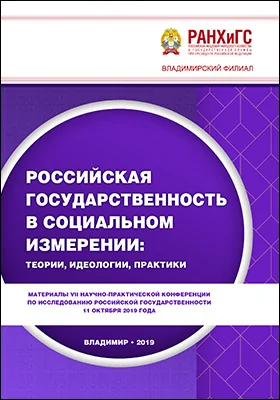

Российская государственность в социальном измерении: теории, идеологии, практики
В сборнике материалов научно-практической конференции представлены научные работы, посвященные изучению различных моделей и механизмов взаимодействия и взаимовлияния государства и социальных процессов, принципов согласования социальных интересов, путей решения российской государственностью социальных проблем XXI века. В статьях сборника отражен богатый спектр разнообразных теорий, идеологических обоснований, моделей, механизмов и практик социальной политики в России, а также актуальный зарубежный опыт реализации государственной политики в социальной сфере.Книга рекомендуется ученым, специалистам, политикам, государственным служащим, всем интересующимся историей и перспективами развития российской государственности.Печатается по решению ученого совета Владимирского филиала РАНХиГС.

Содержание
Содержание книги "Российская государственность в социальном измерении: теории, идеологии, практики : материалы VII научно-практической конференции по исследованию российской государственности, 11 октября 2019 г."
Отрывок из книги
51 © Shanna Bruer-Hess Ph.D., Assistant Professor Department of Political Economy and Commerce Monmouth College, Monmouth, Illinois, USA THE GENERATION Z COHORT: A CROSS-CULTURAL DISCUSSION OF GLOBAL POST-SECONDARY EDUCATIONAL OPPORTUNITIES Introduction According to the famous text written by Friedman (2005), the world is becoming increasingly flat and businesses and employees are developing progressively similar competencies and proficiencies. This concept is further discussed by Mizinjak (2015) as he develops an idea known as “uniculturalism” in which individuals are becoming increasingly similar regardless of geographic location as a result of increased technology, education, and globalization. It is the premise of this article to discuss educational attainment, the Generation Z cohort, and advancements in media usage as applied to three countries – Germany, Russia, and the United States– in the context that the world (and these countries in particular) is becoming increasingly similar. The conversation will then move to the potential of global education as a way to increase student satisfaction, improve learning outcomes, and continue the globalization and interconnectivity of people and businesses worldwide. Generation Z The term generation is defined by Strauss (1992) as the time frame between the birth of a child to the time in which they become an adult. While previously viewed as an approximately 18 to 20 year time period, cultural trends in which parents are having children at later ages have created a greater generation gap. The more modern definition of generation developed by the Cambridge dictionary (2018) is now used. This definition looks more broadly at a time period of 25 to 30 years, a more common time frame in which people give birth, see their children grow to adulthood, and have children of their own. By clustering individuals into genera...










Внимание!
При обнаружении неточностей или ошибок в описании книги "Российская государственность в социальном измерении: теории, идеологии, практики : материалы VII научно-практической конференции по исследованию российской государственности, 11 октября 2019 г. (автор )", просим Вас отправить сообщение на почту help@directmedia.ru. Благодарим!
и мы свяжемся с вами в течение 15 минут

за оставленную заявку