

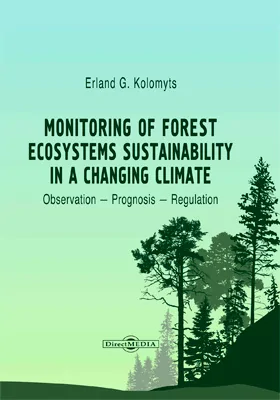

Monitoring of Forest Ecosystems Sustainability in a Changing Climate: Observation — Prognosis — Regulation
The book outlines the new working concept of geo-ecological forest monitoring at the present stage of global warming. For the first time, the full triad of monitoring in its classical definition is considered: «observation (state assessment) — control (prediction) — management (adaptation, feedback, regulation)». The monograph first reports a comprehensive topo-ecological prediction concept as a scientific and methodological basis of local monitoring of natural ecosystems under global climatic changes. The methods of local landscapeecological forecast developed by the author on the basis of empirical-statistical modeling are stated. The complex problem of local and regional response to global climate change, still poorly covered in domestic and foreign literature, has been studied. The mechanisms of local response to the global warming anticipated during the 21st century have been assessed by the example of forest ecosystems of the Volga River basin.The landscape-ecological analysis and forecast were carried out on specific examples, with the involvement of the mass of field factual material collected by the author and with the use of methods of empirical simulation of calculated predicted situations. Forecasts of changes in the biological cycle, including the productivity of forests, are given. Analytical and cartographic models of the functional stability of forest ecosystems are also presented. Quantitative predictive estimates of local and regional regulation of the carbon cycle by forest ecosystems are given for scenarios of modern global warming. One of the possible ways to achieve the environmental goals provided for by the Paris Agreement on climate change has been implemented. An experiment was conducted to numerically solve a dual problem: 1) absorption of CO2 from the atmosphere by forest communities during global warming and 2) their adaptation to these climate changes, which should ensure the effectiveness of the adsorption itself.For students, graduate students and young scientists as an educational and reference tool in the field of landscape ecology, environmental modeling and forecasting.

Содержание
Содержание книги "Monitoring of Forest Ecosystems Sustainability in a Changing Climate: Observation — Prognosis — Regulation "
Отрывок из книги
The ecological role of forests is particularly important, firstly in the forest-deficient regions, which include practically the entire middle belt of the European Russia (Losev, 2001; Korotkov et al., 2020; Maksimiva et al., 2021). The requirement to preserve the reproduction of forest resources at the southern border of the mid-latitude forest zone, where forest communities are in the near-critical states, is among the funda-mental ecological problems (Smirnova, 2004; Zamolodchikov et al., 2014; Gauthier et al., 2015; Kharuk et al., 2016). It has been always of high priority for European Russia, within which there is a vast transition band from forest to steppe, i. e. the boreal ecotone (Kolomyts, 2005; 2018, a, b), is a part of the industrial and demo-graphic “core” of the Russia. It is a rather extensive transition zone from the boreal (predominantly coniferous-forest) belt to the sub-boreal (forest-steppe and steppe) one. Here, the forest formations are under modern hydrothermal conditions close to the critical ones (Bazilevich et al., 1986; Glazovsky et al., 1992; Glazovsky, 2004). The main catchment area of the Volga River basin is to serve as an object of lo-cal and regional monitoring of the sustainable development of forests in the southern margin of the boreal belt of the East European subcontinent under the conditions of modern global climate change. This territory is included in three world centers of extreme anthropogenic destabilization of the natural environment, with the loss of up to 80–90 % of the forest cover area (Table 1.1; Fig. 1.1) and with the dominance of sec-ondary associations (Losev, 2001). Even in the taiga zone of European Russia, by the beginning of the 1990s, slightly more than 60 % of forest areas remained undisturbed. In the remaining Upper Volga-Oka forests, more than 50 % loss of phytomass occurred. Based on processing the recent satellite data from ...






























Внимание!
При обнаружении неточностей или ошибок в описании книги "Monitoring of Forest Ecosystems Sustainability in a Changing Climate: Observation — Prognosis — Regulation = [Коломыц, Е. Г. Мониторинг устойчивости лесных экосистем в условиях меняющегося климата : наблюдение — прогноз — регулирование] (автор Erland Kolomyts)", просим Вас отправить сообщение на почту help@directmedia.ru. Благодарим!
и мы свяжемся с вами в течение 15 минут

за оставленную заявку