

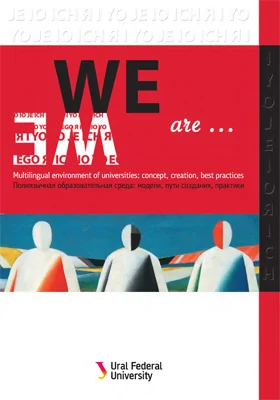
Полиязычная образовательная среда
Здесь можно купить книгу "Полиязычная образовательная среда" в печатном или электронном виде. Также, Вы можете прочесть аннотацию, цитаты и содержание, ознакомиться и оставить отзывы (комментарии) об этой книге.
Форматы: PDF
Издательство: Издательство Уральского университета
Год: 2016
Место издания: Екатеринбург
ISBN: 978-5-7996-1673-1
Страниц: 127
Артикул: 99275


Краткая аннотация книги "Полиязычная образовательная среда"
В процессе глобализации наука и образование приобретают международное измерение. Университеты во всем мире ставят перед собой задачу вхождения в международное научно-образовательное пространство. Это пространство объединяет представителей различных культур, говорящих на разных языках. Английский язык позволяет преодолеть языковые барьеры и приобретает особое значение как основной инструмент коммуникации. Однако доминирование английского языка воспринимается не только как исключительно благотворное, но и как вызывающее диссонанс в академическом сообществе.Вместе с российскими и зарубежными экспертами мы предлагаем администраторам университетов, преподавателям иностранных языков и всем, кого может интересовать данная тематика, поразмышлять над различными проблемами, решениями и моделями создания комфортной и в конечном итоге более конкурентоспособной языковой и культурной среды университетов.
Содержание книги "Полиязычная образовательная среда : модели, пути создания, практики"
Полиязычная образовательная среда: пространство выбора
Моносреда – эта у нас установка такая! Интервью с Артемом Рыкуном
Полиязычное пространство внутренних коммуникаций университета. Интервью с Юлией Гринкевич
Многоязычие – это убеждение. Интервью c Франсин-Доминик Лиштенан
Интернационализация на Дальнем Востоке: ориентация на Восток? Интервью с Мариной Гринцевич
«Utilitarianism or Art» or why foreign faculty do not learn Danish. Interview with Annika Hvithamar and Tine Roesen
Education does not necessarily reflect national ideology. Interview with Simon Smith
Без полиязычности невозможно стать образованным человеком. Интервью с Максимом Хомяковым
Internationalization is a policy, not only a slogan. Interview with Fang Fanquan
Приоритет надо отдавать качеству. Интервью с Ольгой Вершининой
Multilingualism in action. Interview wth Deise Prina Dutra
More and more students want to develop their careers in a Chinese context. Interview with Xin Zhang
Мне неуютно без английского, конечно. Интервью с Лю Цзюньмэй
Без языка инженеру нельзя. Интервью с Людмилой Болсуновской
В каждом подразделении должен быть человек, владеющий английским. Интервью с Марией Дидковской
Lingua francas come and go. Interview with Sue Wright and Lin Zheng
В заключение
Все отзывы о книге Полиязычная образовательная среда : модели, пути создания, практики
Отрывок из книги Полиязычная образовательная среда : модели, пути создания, практики
43«Utilitarianism or Art», or why foreign faculty do not learn Danishin cross-cultural and regional studies, comparative regional studies and humanistic studies of the regions beyond the West, so to say. We have programs focusing on the Arabic world, Russia, Europe and Asia, from East to South-East Asia, and we also have programs in cross-cultural studies, comparative cultural studies, minority studies and religion. Tine:– My name is Tine Roesen. I’m an associate professor of Russian Literature at this department. And I’m also the Vice Head of Studies. – As you know, Russia has launched the program of internationalization of education, and at the moment we are very optimistic about the introduction of English language courses for students and specialized English courses for our staff. We are also trying to encourage our professors to write articles in English and provide them with the necessary support in this sphere. I would like to ask you about your specific context of internationalization of education because you are ahead of us in this process. Were there any specific steps taken to build up a multilingual or English environment at universities in Denmark? Tine:– Yes. We have several declarations adopted at the level of the Ministry of Education and at the University level. It is declared that we want to have bilingual education. English should be introduced and used widely but we must not forget Danish, so we should also make publications in Danish and teach in Danish. However, the efforts to actually ensure this have not been very systematic, so this is being implemented in a lot of different ways at different faculties and departments.Annika:– We come from a small country, so the number of Danish language speakers is small. English has always been very important and it is still dominant in Denmark. Our children grow up to be, if not bilingual, then familiar with English. My son was almost fluent in English when he was fourteen and not only because he pla...
С книгой "Полиязычная образовательная среда" читают









Внимание!
При обнаружении неточностей или ошибок в описании книги "Полиязычная образовательная среда : модели, пути создания, практики (автор )", просим Вас отправить сообщение на почту help@directmedia.ru. Благодарим!
и мы свяжемся с вами в течение 15 минут

за оставленную заявку