

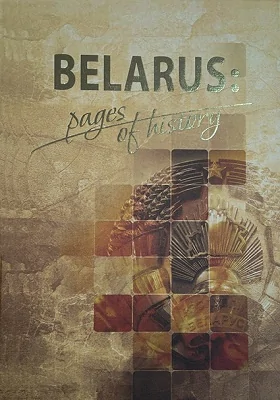

Belarus: pages of history
The book describes the history of Belarus starting from the ancient times till present days, the place, role, contribution and achievements of the Belarusian nation within the European civilization based on the most updated conceptual and methodological approaches to history as well as the public national ideology of the Republic of Belarus.The book aims at a wide audience and all those people interested in the Belarusian history.

Содержание
Содержание книги "Belarus: pages of history "
Отрывок из книги
21ORigiNs OF tHE BElARusiAN NAtiONof the 15th century the concept “Be-laya Rus” (White Rus) (geographi-cally and ethnically) was associated with the lands of Polotsk (Polack) area, which were parts of the Great Duchy of Lithuania. In the 1st half of the 16th century the Polish histo-rian M. Kromer in his works “His-tory of Poles” (1555) and “Poland” (1575) was the first to use the term “Belaya Rus” (Bielaja Ruś) only re-lated to the territory of modern Belarus. Then M. Stryjkovsky in his “Chronicle” (1582) was one of the first to introduce a scientific eth-nonym “Belarusians” in the meaning close to the contemporary one. After signing the Lublin (1569) and especially the Brest (1596) Uniate agreements the part of the po-pulation residing in Vitebsk (Viciebsk) and Mogilev (Mahilioŭ) re-gions loyal to Orthodoxy, began to call themselves “Belorustsy”, “Bela rusians”. In the official documents of the 17th century such terms and concepts as “the Belarusian Orthodox Diocese”, “a Be-larusian bishop”.For the first time these terms and concepts were noted in 1623 in the documents of Warsaw Sejm, then in 1675 – in legal acts by King Jan Sobessky, fixed in articles of the “Eternal Peace” signed in 1686 by Rzeczpospolita and Russia. The terms “Belarusians” and “Belarus” got their official international political and legal status at the end of the 18th – the beginning of the 19th centuries. In 1796 Catherine II united Polotsk (Polack) and Mogilev (Mahilioŭ) pro-vinces into one province area with the capital in Vitebsk (Viciebsk); this province – the only one in Russia – had the national and ethnic identity because it got the name “Byelorusskaya”. By the end of the 19th – to the beginning of the 20th centuries the term “Bela rus” included Vitebsk (Viciebsk), Mogilev (Mahilioŭ), Minsk, Grodno (Hrodna), Vilnya (Vilnia) provinces of Russia, where mostly Bela-rusians lived. After the terms “Belarusians”, “Belarus” b...






Внимание!
При обнаружении неточностей или ошибок в описании книги "Belarus: pages of history = Беларусь: страницы истории (автор )", просим Вас отправить сообщение на почту help@directmedia.ru. Благодарим!
и мы свяжемся с вами в течение 15 минут

за оставленную заявку