

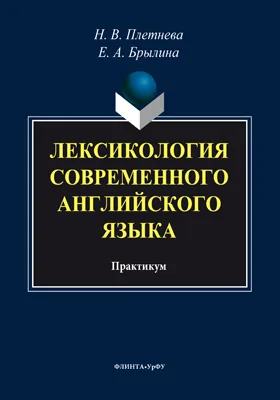
Лексикология современного английского языка
Здесь можно купить книгу "Лексикология современного английского языка" в печатном или электронном виде. Также, Вы можете прочесть аннотацию, цитаты и содержание, ознакомиться и оставить отзывы (комментарии) об этой книге.
Автор: Н. Плетнева, Е. Брылина
Форматы: PDF
Издательство: Флинта|Уральский федеральный университет (УрФУ)
Год: 2017
Место издания: Москва
ISBN: 978-5-9765-3054-6 (ФЛИНТА). – ISBN 978-5-7996-1570-3 (Изд-во УрФУ)
Страниц: 57
Артикул: 93812


Краткая аннотация книги "Лексикология современного английского языка"
Практикум включает задания и упражнения, способствующие последовательному усвоению как теоретических, так и практических основ курса «лексикология английского языка». Представлены разнообразные тексты из литературных произведений английских и американских авторов для лексикологического анализа. Приводится библиографический список, содержащий как традиционные статьи, так и публикации, отражающие новые научные достижения в данной области.
Практикум адресован студентам-филологам для подготовки к семинарским занятиям и для работы на семинарах.
Содержание книги "Лексикология современного английского языка "
Предисловие
Seminar 1. Semasiology: Semantic Structure of English Words
Seminar 2. Semasiology: Change of Meaning
Seminar 3. Synonyms and Antonyms
Seminar 4. Homonyms
Seminar 5. Morphology
Seminar 6. Main Types of Word Building
Seminar 7. Minor Types of Building
Seminar 8. Phraseology
План и тексты для лексикологического анализа
Вопросы к экзамену
Список рекомендуемой литературы
Все отзывы о книге Лексикология современного английского языка
Отрывок из книги Лексикология современного английского языка
21Seminar 5 morphologytask 1. Retell the following in terms of lexical morphemes vs. grammati-cal morphemes.Words as things uttered split up into phonemes, but phonemes do not take meaning into account. We do not play on the phonemes of a word as we play on the keys of a piano, content with mere sound; when we utter a word we are concerned with the transmission of mean-ing. We need an appropriate kind of fission, then — one that is semantic, not phonemic. Will division into syllables do? Obviously not, for syllables are mechanical and metrical, mere equal ticks of a click or beats in a bar. If I divide (as for children’s reading primer) the word ‘metrical’ into ‘met-ri-саl’, I have learned nothing new about the word: these three syllables are not functional as neutrons, protons, electrons are functional. But if I divide the word as ‘metr-; -ic; -аl’; I have done something rather different. I have indicated that it is made of the root ‘metr-’, which refers to measurement and is found in ‘metronome’ and, in a different phonetic disguise, in ‘metre’, ‘kilometre’, and the rest; ‘-ic’, which is an adjectival ending found also in ‘toxic’, ‘psychic’, etc., but can sometimes indicate a noun, so that ‘metric’ itself can be used in a phrase like ‘Milton’s metric’ with full noun status; ‘-аl’, which is an unambiguous adjectival ending, as in ‘festal’, ‘vernal’, ‘partial’. I have split ‘metrical’ into three contributory forms which (remembering that Greek morph — means ‘form’) I can call morphemes.Let us now take a phrase or sentence and attempt a more extended analysis. This will do: ‘Jack’s father was eating his dinner very quickly’. Here I would suggest the following fission: 1) Mack; 2) ‘-’s’; 3) ‘father’; 4) ‘was’; 5) ‘eat’; 6) ‘-ing’; 7) ‘hi-’; 8) ‘-s’; 9) ‘dinner’; 10) ‘very’; 11) ‘quick’; 12) ‘-ly’ — making a total of twelve morphemes. ‘Jack’ can exist on its own, but the addition of ‘-’s’ (a morpheme denoting
С книгой "Лексикология современного английского языка" читают









Внимание!
При обнаружении неточностей или ошибок в описании книги "Лексикология современного английского языка (автор Н. Плетнева, Е. Брылина)", просим Вас отправить сообщение на почту help@directmedia.ru. Благодарим!
и мы свяжемся с вами в течение 15 минут

за оставленную заявку