


Употребление неличных форм глагола в английском языке
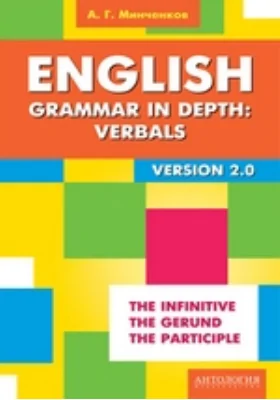
В учебном пособии представлено современное описание неличных форм английского глагола (инфинитива, герундия, причастия). Оно состоит из двух частей – теоретической и практической. В теоретической части описаны формы и особенности употребления неличных форм глагола. Сложный материал представлен в доступной форме. Практическая часть включает в себя разнообразные виды упражнений, обеспечивающих прочное усвоение предложенного в первой части материала.Пособие может быть использовано на занятиях по практической грамматике, а также для самостоятельной работы студентов.

Содержание
Содержание книги "Употребление неличных форм глагола в английском языке "
Отрывок из книги
Part I. The Verbals: THE INFINITIVE15• He was rumoured to be writing a new book.• He was understood to have left for Canada.• His theory was proved to be correct. Note: after the verb consider, the infi nitive of the verb be is often omitted, and consider is followed by a noun or an adjective, so that there is no infi nitive construction at all. Compare the following two sentences:• The Emperor was then still considered to be a living god. (Subjective Infi nitive Construction)• Wild boars were once considered a pest by farmers. (No infi nitive construction)The SIC is also used with the following active verbs:to seem She seemed to believe me.to appear (= ‘to seem’) No records of the event appear to survive.to turn out It turned out to be a very nice party.to prove (= ‘to turn out’) It has proved to be quite useless.to happen She happened to be near at the moment.to chance (= ‘to happen’) I chanced to notice her.Finally, the SIC is used with expressions denoting varying degrees of certainty – be likely, be unlikely, be sure, be certain:• She was likely to forget it quite soon.• The dispute is unlikely to be settled for a long time.• The growth in demand is certain to drive up the price.2.3 THE FORTOINFINITIVE CONSTRUCTIONIn the for-to-infi nitive construction the infi nitive is in predicate relation to a noun (in the common case) or a pronoun (in the objective case) preceded by the preposition for:• I waited for them to say something.
Минченков А. Г. другие книги автора











Внимание!
При обнаружении неточностей или ошибок в описании книги "Употребление неличных форм глагола в английском языке = English Grammar in Depth: Verbals (автор Алексей Минченков)", просим Вас отправить сообщение на почту help@directmedia.ru. Благодарим!
и мы свяжемся с вами в течение 15 минут

за оставленную заявку