


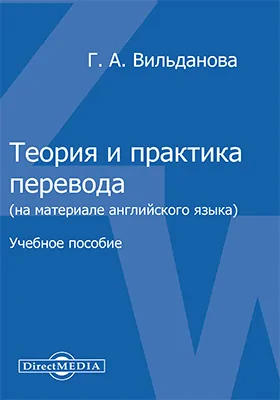
Теория и практика перевода
Учебное пособие содержит теоретический материал по курсу «Теория и практика перевода» и практикум перевода для аудиторной и самостоятельной работы. Материал пособия направлен на освоение и развитие практических навыков перевода с английского языка на русский и наоборот.Пособие может быть использовано в рамках учебного процесса на факультетах иностранных языков.

Содержание
Содержание книги "Теория и практика перевода (на материале английского языка)"
Отрывок из книги
7. What tasks does the theory of translation discipline deal with? Does itgive instructions how to translate?
8. What role did translation play in the medieval ages?
9. What periods stand out in the history of translation?
10.Can you explain what is meant by qualitative and quantitativechanges in translation process?
11.When was the first valuable theory of translation formulated?
12.What translation theories emerged in this country and abroad?
13.What is the advantage of the contemporary theory of translation?
14.How are units of translation defined?15.What view points on the translation unit are there?
Exercise 1. Read and translate into Russian the following extracts: 1. The interpreter’s role as a mediator between cultures as well aslanguages is of critical importance, and here his work is hardest and most rewarding… Hence the need in the interpreting field for “mediating men” or “persons with inter-cultural experiences”. The fact that cultural differences act as a block to understanding, however, is often blithely ignored by both conference participants and interpreters. 2. As opposed to children, interpreters should be heard and not seen.The interpreter must try adapt to the speaker’s accent and take into account his nationality and cultural background, whether he is being ironic, dispassionate, or deliberately vague. No matter what he may think of the speaker or his ideas, while he is working the interpreteris that speaker, and must convince the listener that he is that person.3. The English-Russian interpreter may have a harder time with agalloping speaker than does his Russian-English counterpart, since the sheer length of Russian words and the structure of the language make English-Russian interpretation thirty-three per cent longer than Russian-English.
Вильданова Г. А. другие книги автора




Внимание!
При обнаружении неточностей или ошибок в описании книги "Теория и практика перевода (на материале английского языка) (автор Гузель Вильданова)", просим Вас отправить сообщение на почту help@directmedia.ru. Благодарим!
и мы свяжемся с вами в течение 15 минут

за оставленную заявку