

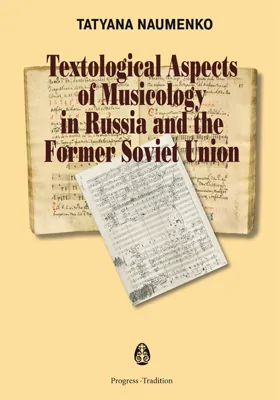

Textological Aspects of Musicology in Russia and the Former Soviet Union
In this monograph, Tatyana Naumenko, Doctor of Arts and a professor at Moscow’s Gnessin Russian Academy of Music, looks at modern Russian musicology through the prism of texts representing it. She mentions subjects addressed in musicological studies, names genres of music that scholars preference to explore, and describes modern methods of research and criteria of assessment, largely with the aim of overcoming Soviet-era dogmatism. Special consideration is given to the writing of academic degree dissertations on music in the former Soviet Union and post-Soviet Russia. The Annex lists dissertations approved between 1970 and 2013.

Содержание
Содержание книги "Textological Aspects of Musicology in Russia and the Former Soviet Union "
Отрывок из книги
56Chapter 2. Some historical aspects of musicological textWhen we speak of the scholarly nature of musicology, we mean not only generally known criteria such as authenticity, absence of contradictions, confirmability, concep-tual coherence, ability to make forecasts, and the possibility of falsification,3 but also an “infrastructure” that takes care of these criteria and has taken centuries to evolve. This infrastructure encompasses the genre diversity of research, a tradition of description of original sources such as doctrines or works of music, serious examination of Russian and foreign scholarly traditions, creation of a single system of concepts and terms. This infrastructure should be able to integrate into the overall scholarly context and follow its accepted formats of exposition such as the writing of theses for academic degrees and the tradition of their public defense.Possibly, one of the reasons for the genuine scholarly character of musicology is the ancient history of music studies. It is natural science that has given rise to schol-arly traditions, and it is indisputable that, for a long time, musicology developed along the same lines. In fact, musicology began to address technical matters much earlier than aesthetic issues.4 It is hard not to accept this point of Alexei Losev: “When we perceive music, it becomes clear to us that, no matter how far music is from logic, it requires the entire phenomenological apparatus of perception that one needs for perceiving things in separation from one another with the aim of logical thinking about them.”5 Seeing “music as an object of logic” comprehensively justifies all the scholarly operations that it has undergone during its long history. It is only natural, therefore, that there gradually evolved an algorithm for the description of music that put musicology among the vener-able and prestigious scholarly disciplines that a while ago laid down rules for intellectual text. Moreover, countless scholarly theor...





Внимание!
При обнаружении неточностей или ошибок в описании книги "Textological Aspects of Musicology in Russia and the Former Soviet Union (автор Tatyana Naumenko)", просим Вас отправить сообщение на почту help@directmedia.ru. Благодарим!
и мы свяжемся с вами в течение 15 минут

за оставленную заявку